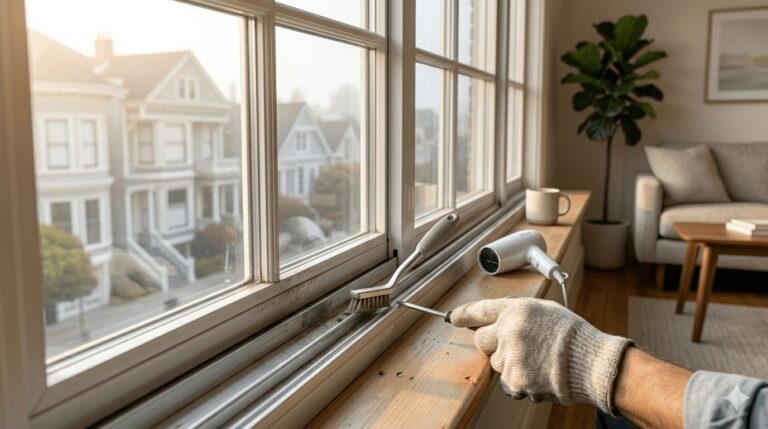
The best-looking parts of a Victorian house are often original sash windows. But their beauty doesn’t excuse them from sticking, rattling, needing repainting sooner than expected, etc. Of course, old doesn’t automatically mean bad (often quite the contrary), but it also doesn’t automatically mean it’s worth saving. The condition is paramount here, including wood, sash movement, drafts, glazing, frame stability. Countless details around the opening. In San Francisco, there also are preservation rules in play.
Why Victorian Sash Windows Are Worth Evaluating Carefully
Traditional sash windows use vertically sliding sections set into a frame, usually wood in older houses. Their proportions are part of the architecture. Rails, old glass, sills, and trim all affect how a Victorian or Edwardian façade looks.
That is why a quick “replace it because it is old” approach can go wrong.
Original windows may still have:
- sound wood through most of the frame;
- older glass worth keeping;
- sash proportions that fit the façade;
- trim details that are difficult to copy.
Still, original does not mean untouchable. Some have been repaired badly over the years. Others have serious decay. Local preservation requirements can narrow the options too.
The right starting point is the window itself, not its age.
Signs Your Original Sash Windows May Be Restorable
A sash that barely moves can look worse than it actually is. Sometimes it is paint buildup. Sometimes a cord, balance, lock, or glazing has failed. That is different from a frame decaying through several joints.
Restoration may still make sense when:
- deterioration is limited to a few areas;
- the main frame remains solid;
- the sash sticks because of paint or hardware problems;
- drafts seem concentrated around gaps and worn weatherstripping;
- loose hardware can be repaired;
- glazing compound has failed around otherwise sound glass.
Small cracks or a sash that needs adjustment do not automatically mean the whole assembly is finished.
Hidden damage is the catch. Lower corners and sill areas can hold more rot than the surface shows. A visual check is useful, just not enough for a final decision. Our guide on how to tell if your windows are actually failing.
When Replacing Victorian Sash Windows May Make More Sense
Replacement starts to look more reasonable when problems are spread through the assembly and repairs keep becoming bigger.
A few situations stand out:
- Rot affects structural parts of the sash or frame in several places.
- Multiple components have failed and previous repairs have not lasted.
- Air leakage remains significant after sensible repair and sealing work.
- The existing unit cannot reasonably meet the performance goals for the room.
- Restoration has become extensive enough that much of the assembly needs rebuilding.
No single symptom decides it. One damaged sill may be repairable. Widespread decay, loose joints, and repeated water entry are a different case.
The point is to compare the real scope. Not “repair” in the abstract against “new window” in the abstract.
Restoration vs. Replacement: What Are the Trade-Offs?
There is no clean universal winner here.
| Factor | Restoration | Replacement |
| Original details | Keeps existing profiles, glass, and woodwork where serviceable | Can reproduce some traditional features, though rarely every detail exactly |
| Operation | Repairs can improve sticking, balances, locks, and sash movement | New hardware may provide smoother operation |
| Air leakage | Weatherstripping and repair may reduce gaps | New units may improve air control when fitted and sealed correctly |
| Maintenance | Original wood usually needs ongoing finish care | Depends on frame material and finish |
| Project scope | Can be small or highly labor-intensive | Depends on unit size, installation method, and opening condition |
| Cost factors | Craft labor, decay, glazing, hardware, paint | Unit, custom size, trim, installation, surrounding repair |
| Historic review | Often keeps more original fabric | Exterior changes may receive more scrutiny |
Restoration can stay fairly contained when the wood is sound. Once large sections need rebuilding, labor changes quickly.
Replacement has its own variables too. Custom sizing, trim work, access, and surrounding repairs can add a lot.
Can Replacement Windows Preserve a Victorian Home’s Appearance?
Sometimes, yes. Perfectly? Not necessarily.
A replacement needs to be judged on details people actually see:
- sash height and width;
- frame depth;
- visible glass area;
- muntin pattern;
- sill profile;
- exterior casing;
- finish and material.
A new unit can fit and still look wrong if the frame is too bulky or the sash proportions shift.
For homeowners considering wood window replacement, the material helps with the traditional look, but it does not settle the design question. Profile still counts. So does trim.
Modern double-hung windows can reproduce some familiar sash proportions and operation. Some do it quite well. Others look noticeably heavier. Actual samples tell you more than a “traditional” label.
What About Energy Efficiency and Drafts?
Drafts are often blamed on the pane itself. Sometimes the air is entering somewhere else entirely.
It may be coming through:
- the edges of the sash;
- meeting rails;
- loose joints;
- failed seals;
- the gap between frame and wall.
That changes the repair.
Weatherstripping can help with perimeter gaps. Reglazing may deal with loose glass and failed putty. Hardware adjustment can improve how tightly a sash closes. Larger frame damage may call for larger work, sometimes replacement.
Modern glazing and newer frames can improve thermal performance. Installation still matters. A good product in a badly sealed opening will underperform.
Energy savings should not be used as a guaranteed payback argument. Better to identify where the comfort problem starts and address that.
Historic District Rules and Victorian Window Replacement in San Francisco
San Francisco can add another layer because some properties sit in historic districts or have preservation constraints tied to exterior changes.
Not every Victorian has the same requirements.
What applies can depend on:
- the individual property;
- the district;
- which side of the house is affected;
- visibility from the street;
- the amount of exterior change proposed.
Check that before ordering, especially if frame material, sash proportions, muntins, or trim will change.
An assessment needs two tracks at once. What condition is the existing window actually in? And what changes may be restricted or reviewed?
Leaving that second question until after product selection creates unnecessary backtracking.
How to Decide: A Practical Assessment Checklist
It helps to stop thinking in terms of “old versus new” and look at the opening piece by piece.
Ask:
- Is the deterioration local or spread through the frame?
- Why do the sashes stick? Paint, swelling, damaged balances, and distortion do not call for the same repair.
- Where is the air entering? Around the sash, through damaged joints, or around the full frame?
- Is the original frame still structurally sound?
- How important are the original profile, glass, and material to the façade?
- Are there local restrictions that affect replacement?
- What is actually included in each quote?
That last one gets skipped too often. A restoration price may exclude major wood rebuilding. A replacement quote may leave out trim or repair around the opening.
Compare scopes. Then compare prices.
Get Advice Before You Commit to Restoration or Replacement
Victorian sash windows are not always restoration projects just because they’re not, nor are they automatically a replacement projects because of sticks or air leakage. As we said in the very beginning, condition comes first, before anything else. Then appearance and preservation are tied into the decision.
If repair is realistic, the scope should say what gets repaired and what stays original. If replacement looks more sensible, check the proposed unit against the house, not just the rough opening.
That assessment early on can prevent a very expensive wrong turn later.
Ready for a Consultation?
Get a Free Estimate Today!