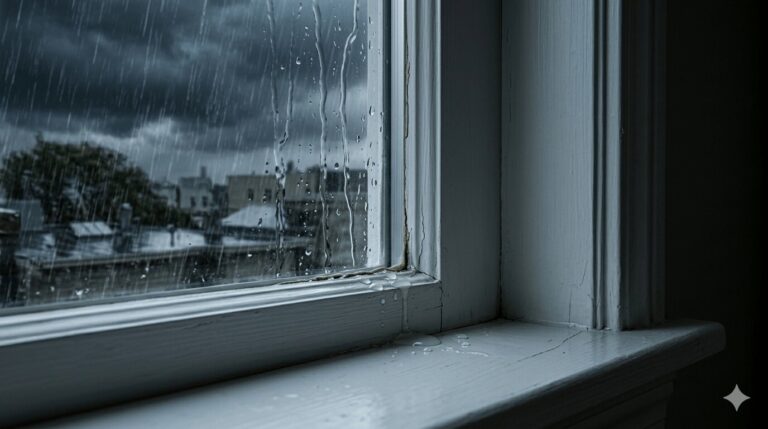
A 15-year-old window can look terrible. Faded frame. Scratched glass. Hardware that feels like it has personally given up on life. Ugly doesn’t necessarily mean broken, though.
That’s the part people tend to miss when they’re trying to figure out how to tell if windows are failing. Age matters, sure. But a window doesn’t suddenly become defective on its 15th birthday. There are actual things going wrong when a window is failing, and most of them leave clues.
Fog between the glass. Drafts. A frame that has started moving where it shouldn’t. A window that suddenly needs a shoulder check to close. Those are more useful clues than the calendar.
Foggy Windows Between the Panes
This one is hard to miss once you know what you’re looking at.
You have two panes of glass separated by a sealed space. That space is part of what makes an insulated glass unit work. It may contain air or insulating gas, depending on the window. Then the seal around the glass fails. Moisture gets inside. Now you’ve got a permanently foggy window.
And no amount of Windex is going to save you.
If condensation is on the room side of the glass, that’s different. Same if it’s on the exterior surface. Those can be caused by humidity, temperature and weather. Foggy windows between panes are another story. You can’t wipe that condensation away because it’s trapped inside the insulated glass unit. Once the seal has failed, the unit has lost the airtight space it was designed to maintain. That’s one of the clearest signs of window seal failure.
The good news? A failed glass seal doesn’t always mean the entire window frame has to be replaced. In some cases, the insulated glass unit can be replaced while the existing frame stays put. Much less dramatic. Also cheaper.
The Frame Has Started Acting Weird
Windows are supposed to open and close. That’s their whole thing. So when a window that used to glide open suddenly requires both hands, stop pretending it’s just “an old window.” Try it slowly.
Does the sash rub against one side? Does the frame look slightly shifted? Are the gaps around the perimeter uneven? Does the window seem to have dropped a little? Those can be signs that the frame has warped, shifted, or deteriorated.
Now, don’t blame the frame too quickly. Sometimes it’s just hardware. A hinge needs lubrication. A track is dirty. A lock is sticking. Fine. Clean it. Lubricate it. See what happens. But if the frame itself is out of alignment, lubricant isn’t going to fix it. That’s like putting oil on a crooked door and expecting the house to straighten itself.
A window that has become difficult to operate is worth investigating, especially when the problem comes with visible changes around the frame.
Listen to the Window
Windows make noises. Houses make noises. Everything makes noises. But there is a difference between an old window creaking during a storm and one that whistles every time the wind comes from the west.
That whistle can mean air is finding its way through worn weatherstripping, a gap around the frame, or another weak point in the seal. Then there’s rattling. Glass shouldn’t normally sit there shaking around in its frame like a loose picture in a truck. A persistent rattle can point to a loose stop, damaged frame, loose component, or a problem with the glass assembly itself.
Again, context matters.
One weird noise during a 50-mph gust? Maybe the house is just having a moment. The same whistle every cold morning? Different conversation entirely.
Then There Are the Quieter Warning Signs
Some window problems don’t announce themselves. They just start costing you money.
If your heating or cooling bills suddenly jump and nothing else has changed, take a look at the windows. This isn’t proof that the windows are failing—insulation, HVAC performance, weather and utility rates can all move the number around—but drafts and poor sealing can absolutely contribute.
Then inspect the windows themselves. Cracked frames. Soft or rotting wood. Rusting hardware. Damaged weatherstripping. A lock that doesn’t actually lock. Water stains around the opening. Gaps where the frame meets the wall. These are the “windows need replacing” signs worth taking seriously.
A broken lock, for example, isn’t just annoying. It can affect security and weather sealing. And visible rot deserves attention because the soft piece you can see isn’t necessarily the only piece that’s damaged.
Wood has a habit of keeping secrets.
What Can You Check Yourself?
Quite a lot, actually.
On a cold or windy day, put your hand around the perimeter of the window. Move slowly. You’re looking for noticeable air movement or cold spots. You can also use a candle or incense stick near the frame and watch the flame or smoke for movement. Carefully, obviously. We’re checking windows, not auditioning for a fire department commercial.
Look at the weatherstripping, too. Is it cracked? Flattened? Missing in places? Pulling away? Then look closely at the glass. Is the moisture on the surface you can touch? Or is it trapped between the panes? That distinction tells you a lot.
You can also open and close the window several times. Does it move smoothly? Does one side drag? Does the lock line up? Those simple checks won’t diagnose every problem, but they’ll tell you when it’s time to stop guessing.
A failed glass seal, hidden rot, structural frame damage, or serious water intrusion is where a professional should take over.
So, When to Replace Old Windows?
This is where things get less exciting, because there isn’t a magic number.
A 20-year-old window can still be doing its job. If it opens properly, locks properly, doesn’t leak, has intact seals and isn’t creating obvious drafts, age alone isn’t necessarily a reason to replace it. But suppose that same window has fogged glass, deteriorating weatherstripping, a frame that’s shifting, a broken lock and a draft strong enough to move the curtains.
Now we’re having a different conversation.
One failed component can often be repaired. Several failing components start changing the economics. That’s the answer everyone searching “when to replace old windows” online are looking for: not necessarily when they’re old, but when enough of the window has stopped doing what it was supposed to do that repairs become a recurring hobby.
Nobody needs that kind of hobby.
FAQ
Can a fogged double-pane window be repaired without replacing the whole unit?
Often, yes. The insulated glass unit may be replaceable without replacing the entire frame, assuming the existing frame is still sound. If the frame is also warped, rotted or damaged, full replacement may make more sense.
How long do windows typically last in Bay Area conditions?
There’s no universal expiration date. Material, installation quality, maintenance, exposure and the window itself all matter. A properly maintained window can last for decades, while another can develop problems much earlier.
Coastal exposure, inland heat, and everything in between can also change how quickly materials deteriorate. Look at the window. Not just its birthday.
Should I replace one window or all of them if I only find one bad sign?
Not necessarily. If one window has a failed glass seal and the others are working normally, repairing or replacing that one unit may be enough. If several windows are fogging, sticking, leaking or deteriorating at the same time, then it’s worth comparing the cost of repeated repairs with replacement.
One bad window doesn’t automatically drag the whole family into the witness protection program.
Does a manufacturer’s warranty cover seal failure after 10+ years?
It depends on the manufacturer, window line and warranty terms. Some insulated glass units have longer coverage for seal failure, while others have different limits and exclusions. If you still have the original paperwork, check it. If not, the manufacturer or installer may be able to identify the coverage from the window information.
What’s usually cheaper in the long run—repair or replacement, once multiple signs show up?
It depends on what has actually failed.
Replacing weatherstripping is one thing. Replacing a rotten frame, failed glass, damaged hardware and dealing with persistent air leakage is another. Once several problems start stacking up, get an assessment before paying for another isolated repair.
Sometimes the window needs one part. Sometimes the whole thing has simply reached the end of the road. And those are very different invoices.
Ready for a Consultation?
Get a Free Estimate Today!