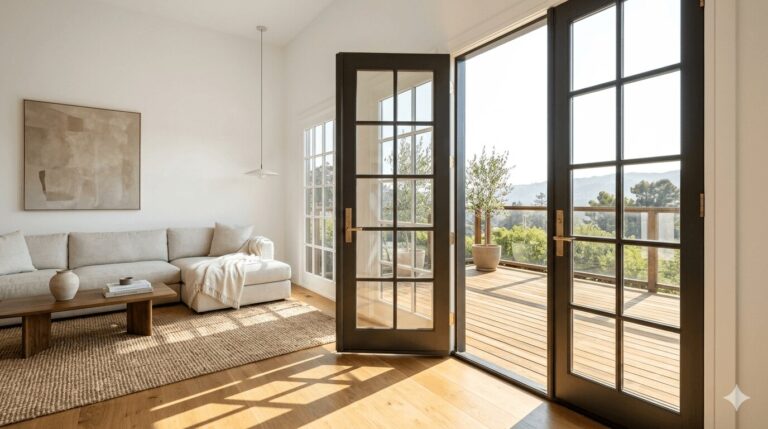
Black window frames are everywhere right now.
Modern houses. Farmhouse remodels. New builds trying very hard not to look like new builds. And, increasingly, San Francisco Victorians and Edwardians where somebody wants to keep the old character but give the windows a sharper, darker outline.
Fair enough. Black looks good.
But there is a small problem with treating it as purely a design decision: black is not just a color when the thing you’re buying sits in direct sunlight all afternoon. It is also a heat-management decision.
Dark surfaces absorb more solar energy than light ones, and vinyl has considerably more thermal expansion than fiberglass. That doesn’t mean every black vinyl window is going to curl up like a potato chip. Modern products can be engineered specifically for dark colors, using reflective pigments, capstocks, reinforcement and other tricks to control heat buildup.
Still, before you say, “Just make them black,” it is worth knowing what happens after the pretty part.
Why Black Is a Structural Question, Not Just a Color Choice
Here is the basic physics without turning this into a materials-science lecture. White reflects a lot of sunlight. Black absorbs more of it. A dark vinyl frame sitting in direct sun can therefore get much hotter than the surrounding air.
And vinyl moves.
Its coefficient of thermal expansion is substantially higher than fiberglass or glass. Marvin’s current materials data, for example, lists a coefficient of thermal expansion of about 4.0 for vinyl versus 0.6 for glass and 0.4 for Ultrex fiberglass. That movement matters quite a lot.
A frame gets hot, expands. It cools, contracts. Do that over and over, particularly on a large opening exposed to strong afternoon sun, and you are asking the material to move while the glass, seals and surrounding structure are doing something slightly different.
That is where problems can begin: distortion, binding, gaps and, in some cases, stress around the insulating glass seal.
The exact temperature where trouble starts depends on the specific formulation and construction. Some PVC products are designed around temperatures in the 150⁰F range, while engineered dark-vinyl systems are tested to handle much more. So don’t treat one temperature number as a universal failure point.
Which is also why warranties and installation requirements deserve a glance before ordering.
Vinyl: When Black Vinyl Is Actually Fine
Black vinyl gets blamed for a lot of things it doesn’t necessarily deserve. Factory-produced black vinyl is not the same thing as taking a twenty-year-old white window and painting it black with exterior paint.
Modern dark vinyl products can use specially formulated pigments, coextruded capstocks and reflective technology designed to reduce heat buildup. Some manufacturers specifically engineer the dark outer layer to reflect more solar energy while keeping the appearance black. That’s a big distinction. So, yes, black vinyl windows can be a perfectly reasonable choice.
Location matters too.
A north-facing window in a shaded San Francisco courtyard has a very different thermal life than a giant black vinyl slider facing west in an inland part of San Jose. Same color. A completely different situation. Coastal fog helps too. A foggy afternoon in San Francisco or Sausalito is not exactly the same heat load as a full afternoon of direct inland sun.
Still, ask for the actual product specification. Not “black vinyl is fine.” The exact window.
Fiberglass: Why It Is the Easier Choice for Black
This is where black fiberglass windows start making a lot of sense.
Fiberglass has a much lower rate of thermal expansion than vinyl and is much closer to glass in that respect. For example, Marvin lists a heat-deflection temperature of 285⁰F for Ultrex. Translation: fiberglass is not nearly as interested in changing shape every time the sun comes out.
That matters even more with big windows.
A narrow double-hung window is one thing. A six-foot-wide dark slider on a west-facing wall is another. There is simply more frame, more glass, more exposure and more opportunity for small movements to become annoying problems.
Fiberglass also doesn’t soften the way a thermoplastic does under heat. And modern fiberglass finishes can be designed for dark colors without the same concerns about distortion that come with ordinary vinyl.
You pay more. Of course you do.
But if the design absolutely depends on black frames and the opening sits where the sun spends its entire afternoon, the extra material cost can start looking less like a luxury upgrade and more like buying yourself some breathing room.
The Simple Way to Match the Material to the House
Think about the wall first, then the window:
- South-facing/west-facing/strong sun/inland heat: fiberglass deserves serious consideration, especially for large openings.
- North-facing/east-facing/shade/coastal conditions: a properly engineered factory-finished black vinyl window may be completely reasonable.
- Large sliders, picture windows or unusual openings: fiberglass becomes more attractive because the consequences of movement are harder to ignore.
- Black exterior, but you don’t actually want a black interior: ask about dual-color construction. Some vinyl manufacturers offer a black exterior with a white interior, which gives you the architectural contrast outside without turning the living room into a black-frame convention. Pella, for example, currently offers white interiors with black exteriors in several vinyl lines.
And before signing anything, check the warranty language for the exact dark finish and product line. Not the general warranty. The actual one.
FAQ
Can I just paint my existing white windows black?
Technically, paint can be applied to some vinyl products, but that doesn’t make it a good universal idea. Dark paint increases solar heat absorption, and manufacturers may specifically limit painting or warranty coverage. Pella, for example, directs homeowners to its written warranty for the conditions around painting vinyl.
If you want black, factory-finished black is generally the cleaner route.
Does black vinyl really wear out faster than white?
Not automatically.
A properly engineered dark vinyl window can be designed for long-term exposure. The issue is heat buildup, not some magical property of the color black that makes vinyl suddenly fall apart. Cheap or poorly engineered dark vinyl is a completely different story.
How much more does black fiberglass cost versus black vinyl?
There isn’t one reliable percentage because window prices change dramatically with size, operation, glass package, installation and brand.
Fiberglass generally costs more than vinyl. For a large custom opening, though, the material difference can become less important than the total project price.
Do Marvin and Milgard offer the same warranty on black frames as standard colors?
Don’t assume.
Warranty coverage depends on the specific product, finish and manufacturer terms. Marvin’s current fiberglass products specifically advertise dark-color finish performance, while Milgard’s warranty documentation spells out coverage by product and condition. Check the written warranty for the exact window you’re buying before you compare the two.
Is there a middle-ground option—black exterior, white interior?
Yes. And honestly, this is one of the more practical ways to get the look without committing your entire interior to it.
You get the sharp black outline from the street, while the inside stays lighter and easier to work around. Because sometimes the answer isn’t about the “vinyl vs fiberglass black windows” dispute. Sometimes it’s simply: black outside. White inside. Everybody goes home happy.
Ready for a Consultation?
Get a Free Estimate Today!